How Does Medicare Work? What Seniors Need To Know About Medicare

What is Medicare? And the Medicare tax? Who contributes to it? And how does it work? There are a lot of questions about this federal health insurance program. Understanding Medicare and all of its moving parts may seem difficult at first, but all it takes is a little bit of research to understand how to get the most out of it. As a U.S. government health insurance program, Medicare is divided into different plans that cover a variety of healthcare situations—some of which come at a cost to the insured person.

Medicare offers excellent health coverage you can customize to fit your health needs and budget. While this allows the program to provide consumers with multiple-choice options for costs and coverage, it also introduces complexity for those signing up. To alleviate confusion, we created this guide to help you through the process of enrolling in Medicare, including what the different plans are and who’s covered.

What Is Medicare

Medicare is the federal health insurance program that covers 61 million people nationwide and spends over $800 billion every year on healthcare. As the second-largest expenditure in the federal budget behind Social Security, Medicare funds almost a quarter of all healthcare spending in the United States and can be considered the single biggest “insurer” covering Americans. The basics of Medicare include both plans provided by the federal government and those available through private insurers. Different types of plans can cover other parts of your health care.

The plan covers people age 65 or older, younger people who meet specific eligibility criteria, and individuals with certain diseases. As the most common form of healthcare coverage for seniors, it’s divided into four programs: Medicare Part A, Part B, Part C (also known as Medicare Advantage), and Part D for prescription drugs. The program has been in existence since 1965 and provides a way for older Americans to have their health needs taken care of after they retire from the workforce.

What Is the Difference Between Medicare Part A and Part B?

When you become eligible for Medicare, you have to decide which plan is best for you. Original Medicare is provided through the federal government and includes Medicare Part A and Medicare Part B, which both handle different parts of your health care. It’s important to remember that Original Medicare doesn’t cover everything, such as vision and dental coverage.

Medicare Part A

Known as “Hospital Insurance,” Medicare Part A covers costs billed by hospitals or similar inpatient-like settings, such as skilled nursing facilities, hospice, and some home-based healthcare. This plan doesn’t cover long-term or custodial care. When you receive notification that you’re eligible for Medicare Part A, you’ll also be notified about your eligibility for Medicare Part B coverage, which is optional and has a premium for all enrolled members.

Medicare Part B

Generally, Medicare Part B covers costs for outpatient care such as doctor visits, preventative services, ambulance services, certain medical equipment, and mental coverage. This plan also covers certain prescription drugs.

Medicare Advantage vs Medicare: What’s the Difference?

Budgeting for healthcare costs in retirement is tricky since there’s often no way of knowing whether your expenses each year will be minimal or massive, and Medicare isn’t a “one-size-fits-all” approach. There are specific differences between traditional Medicare and Medicare Advantage that are important for people to understand when they first become eligible for Medicare and during the Open Enrollment period.

Traditional Medicare

Traditional Medicare is offered directly through the federal government, and you receive a red, white, and blue card to present to providers. The same level of coverage is available to all enrollees across the country with no pre-existing condition limitations or waiting periods. You can see any doctor, medical provider or visit any facility around the country that accepts Medicare. However, Medicare doesn’t cover long-term care, but it will cover short-term rehabilitation for the first 100 days. There are limits on your charges when you visit participating or non-participating providers as a Medicare beneficiary.

Medicare Advantage

Medicare Advantage is part of the Medicare program offered to seniors and disabled adults who qualify through private plans that contract with the federal government to provide Medicare benefits. Also referred to as Medicare Part C, Medicare Advantage plans are offered through private insurance companies instead of the federal government. Medicare Advantage plans have fixed networks of doctors and hospitals, so your plan will have rules about whether or not you can get care outside of your network. Of course, you’ll pay more for any care you receive outside your network like any plan.

Medicare Advantage enrollment boils down to plan variety, choice, and costs, benefiting healthier people who use fewer services with lower costs. Enrollees are looking for the cost protection of an out-of-pocket limit and the variety of plan options with different premium, copay, and deductible schedules. A range of service options, such as dental, vision, pharmacy, and wellness benefits, are also available.

How to Choose a Medicare Plan

If you plan to travel or split your time residing between more than one state, you will want to enroll in Original Medicare, so you can access care providers anywhere. If you don’t plan to travel and prefer a “turn-key” Medicare experience, an Advantage Plan makes the most sense. You should make sure your desired care providers are part of the approved network before you enroll. Going out of the network for care will result in higher costs and possibly even denials. The current divide between enrollment in the two options is 2/3 Traditional and 1/3 Advantage Plans.

If you sign up for Original Medicare and later decide you would like to try a Medicare Advantage Plan—or vice versa—remember that there are specific enrollment periods when you’re allowed to make changes. You should also keep in mind that different areas have different Medicare Advantage Plans.

When Is Medicare Open Enrollment?

The annual Open Enrollment Period (OEP) for current Medicare recipients to change their coverage runs from October 15th-December 7th. You can change between traditional coverage and Medicare Advantage, switch Part D prescription plans, or move between Advantage Plans as your needs change. It’s also important to compare plans during each enrollment period, as coverage and plans available near you can change year to year.

Since Medicare covers everyone individually, this is also an important time for couples to make sure they are coordinating and re-calibrating coverage to find the best balance for their needs. For example, if one is covered by traditional Medicare and another by Medicare Advantage, and travel plans increase or decrease, should both move to one or the other together? Likewise, if certain drugs become necessary based on changing health conditions, every Part D plan needs a review to determine which plan will best fulfill those needs for the following year.

Special Enrollment

You can change your Medicare Advantage and Medicare prescription drug coverage for life events such as moving, losing existing employer-provided insurance coverage, or getting married. The opportunity to make changes are called Special Enrollment Periods (SEPs). Depending on your SEP type, you may have 60 days before or 60 days after the event to enroll in a plan.

How Much Is Medicare?

It’s important to understand that Medicare does come with costs, and those costs will vary depending on whether you have enrolled in Original Medicare or an Advantage Plan. Medicare Part A is free for most individuals because of payments made through payroll taxes under the Federal Insurance Contributions Act (FICA). You can also qualify for free Medicare Part A due to your spouse’s work history.

Generally, the government will automatically enroll you in Medicare Part A at no cost when you reach 65, as long as you’re already collecting Social Security or Railroad Retirement Benefits. All you need to do is check your mail for your Medicare card, which should arrive about three months prior to your 65th birthday. Coverage is automatic for anyone who receives Social Security benefits, but for those who don’t, enrollment can be done through the SSA website. If you’re not eligible for premium-free Part A, you may be able to purchase the coverage up to $499 each month in 2022. Most people will pay the standard Medicare Part B premium amount, which is $170.10 for 2022.

Under Medicare coverage, you will pay a deductible for your health care before Medicare pays its share. These premiums and out-of-pocket costs will need to be included in your monthly budget. If you miss the correct windows to enroll in Medicare coverage, there may be delays in coverage, or you may get locked into the wrong or inadequate coverage as your care needs change. There is also the risk of financial penalties that will increase premiums, and depending on your annual income levels, you may also pay higher premiums.

Medicare Doesn’t Have to Be Complicated

Medicare was enacted over 50 years ago and has since become one of the most important, popular, and best-run government programs in U.S. history. However, to get the maximum value from the program, enrollees must make informed choices. Understanding enrollment, costs, services, and matching your lifestyle with the specifics of Original Medicare or Medicare Advantage will help you gain the most out of Medicare. In addition, talking with your financial advisor can help you decide which Medicare program is best suited for you and help answer any questions you have during the enrollment period, so contact the experts at Retirement Genius today.


 

View Transcript

Retire like a genius. How to become a Medicare genius? Almost everyone has heard of Medicare but most people really don’t think very much about or understand how this program works. Navigating retirement income health care and long-term care in the United States can be very complex. The more a person can understand about critical entitlement programs the more likely they are to build and live a well-balanced retirement and retire like a genius. Medicare provides Health Care coverage to 64 million people age 65 and above. Medicare is broken into four components part A hospital-based care, part b doctors, outpatient services, and medical devices, part c advantage insurance plans and, part d prescription coverage. So here are some common myths and facts about Medicare. Myth once a person enrolls in Medicare it covers all their health care needs. Fact Medicare is a program broken up into four parts and depending on what coverage options are selected at enrollment it will or will not provide specific coverages. Myth Medicare will cover a spouse and dependents. Fact Medicare is individual coverage only so when to enroll and what coverage to select can impact a spouse or dependents. Myth people have one opening to enroll in Medicare once they turn 65. Fact Medicare enrollment can be delayed after turning 65 and there is an annual open enrollment period from October 15th to December 7th to make changes to plan selections. Myth Medicare provides free health coverage. Fact Medicare requires premiums, deductibles, and co-pays that will vary depending on factors such as plan selection and a person’s income. Myth Medicare covers long-term care. Fact Medicare does not cover long-term care and will only partially pay for 100 days of skilled Rehabilitation upon discharge from a hospital or for 90 days of hospice care . Understanding how entitlement programs work is critical to make sure mistakes are not made that can delay or jeopardize enrollment and access to benefits that a person is entitled to receive. Medicare can play a critical role in a person’s retirement but the more people understand about the program the more they’ll get out of it and help themselves retire like a genius.

The Importance of Daily Routine

senior couple working our
Getting older doesn’t have to mean a life without companionship, mental stimulation, good health, and purpose. With just a little motivation and effort, there are a variety of actions people can take now that will contribute to a joyful aging process throughout their lives.

It is never too early or late to start working toward a healthy and meaningful retirement, no matter your current lifestyle. Daily routines are crucial components of a healthy lifestyle—leading up to and during one’s senior years. Read on to discover the ins and outs of daily routines, ranging from their typical components to their various benefits for seniors.

Why a Consistent Daily Routine Is Important for Seniors

Seniors face challenges unique to their life stage. Isolation, decreased mobility, inconsistent schedules, lack of stimulation, constrained budgets—when allowed to fester, these problems can burden seniors with unnecessary stress, limitations, and damaging influences. However, consistency helps seniors overcome these challenges by grounding their days with regular and positive practices.

It’s critically important for seniors to develop routines that provide the structure to set daily expectations, form good habits, and dedicate time to self-care. Maintaining a daily routine helps seniors avoid slipping into unhealthy patterns. Still, it can also help them minimize the potential adverse effects of aging—loneliness, boredom, and decreased physical and mental activity.

What Should a Senior’s Daily Routine Look Like?

While negative aspects of aging can make some doubt the possibility of a relaxing and rewarding retirement, this life stage comes with many underemphasized advantages. For example, retirement gives seniors the freedom to pursue whatever hobbies and interests strike their fancy. The same applies to their daily routines. While the essential components of a daily routine should generally stay the same, seniors can shape the specifics of their day-to-day schedule based on what they enjoy.

Seniors’ daily routines should contain some essential elements: exercise, healthy eating, socialization, mental engagement, and rest. However, they can choose which form these activities take according to their interests. For example, if they enjoy reading, joining a book club could be a great way to invest time in their hobbies while satisfying their need to socialize. Enjoy going on walks? How about playing a sport like golf or tennis? The benefits of a daily routine that provokes joy include improving physical and mental health and increasing the likelihood that seniors will stick to their routine in the long run.

The Benefits of a Daily Routine for Seniors

It can be difficult to believe that something as simple as a daily routine plays a significant role in creating a pleasurable retirement. Daily routines can help seniors and those close to retirement develop better habits and a satisfying schedule despite current daily habits. Read on to see how the importance of daily routines manifests itself in seniors’ overall well-being, relationships, and acuity.

Attitude

Taking on life and aging with a positive attitude is a fundamental cornerstone of a high-quality lifestyle. Do you take on life’s challenges with zeal or dread? Are you active or sedentary? Do you nurture relationships and pursue hobbies, jobs, or volunteer activities?

Daily routines give a senior’s life structure and purpose that necessitates neither. With purpose comes striving for a healthy mind, body, and, importantly, attitude. Daily routines can provide seniors with a renewed focus, everyday joys, and occupation, boosting their moods and improving their outlook.

Adaptability

Your ability to adjust to the changes in yourself and the world around you is an important skill. Darwin has always been right about one thing—those who best adapt to change are best at thriving. The one thing you can count on in life is that change will be constant. Therefore, prepare to do your best to manage in a positive way changes to your body and mind, your loved ones and relationships, your career and activities, and the world around you.

When the world around seniors transforms, a daily routine is essential. Daily routines create stability in an environment of continual change, helping seniors adapt to incremental changes and major life shifts. Reliable staples in daily schedules allow seniors to remain grounded during transitions.

Relationships

A person who nurtures and seeks to build new relationships is more likely to enjoy a higher quality lifestyle. We give and take from our relationships with significant others, our families, friends, and colleagues—they help give our lives purpose. Being connected is part of being human. It is important to stay socially engaged as we grow older, whether through in-person interactions or from afar.

Even when relationships change over the years, seniors should continue to build new relationships throughout their lives. Daily routines create built-in windows for social interactions, ensuring that seniors make time for meaningful relationships. These routines can satisfy their socialization needs and feed a spark for life.

Activities

An object in motion tends to stay in motion. So, an active lifestyle consisting of hobbies, work, volunteering, family, friends, culture, and nature is more meaningful and healthy than being a couch potato. One of the continuities among people who live long lives is that their lives continue to have meaning even as they age.

Staying engaged in activities through a busy daily routine will allow seniors to bring meaning to others and themselves. Luckily, there are several ways seniors can occupy themselves in their retirement and add exciting activities to their daily routines. Many people continue working or take on a second career in later life. Others find fulfillment by pursuing hobbies, volunteering, learning a new skill, or getting more involved with their family. Though seniors have significant flexibility when choosing activities for their daily routines, all paths will lead to an active and meaningful life.

Diet

We are what we eat. The food and drink we ingest impact our health and quality of life. A diet high in fats, sugars, and salt not only causes obesity but also promotes cardiovascular problems. Vices such as soda, alcohol, tobacco, and drugs can negatively impact longevity. Maintaining a daily routine that sets aside time for preparing healthy meals and drinking sufficient water makes it easy to maintain a consistently healthy diet.

Seniors should create a routine that involves staying well-hydrated, eating leafy vegetables, legumes, grains, and proteins. At the same time, unhealthy items such as sweet treats, alcohol, and salty snacks are enjoyed in moderation. When healthy eating and drinking become a habit after being ingrained in a senior’s daily routine, this has proven to improve quality of life and increase life expectancy.

retired couple cooking

Exercise

As we age, all of our bodies undergo constant change and challenges. Exercise is the key to keeping your body (and mind) sharp through this ongoing process. It is important to incorporate exercise into a senior’s daily routine—improving their strength, balance, flexibility, and constitution as they age. Embedding regular exercise in a daily routine will increase a senior’s longevity and contribute to mobility, independence, health, and happiness throughout the rest of their lives. As these areas become harder to maintain as they age, a daily routine of exercise and movement will mean a better, healthier tomorrow.

Sleep

One component of a daily routine that many people take for granted is rest. The amount of sleep a senior receives directly impacts their body, mind, and attitude. The optimal daily routine will set aside at least eight hours for sleep. However, the importance of daily routines for a proper sleep schedule does not stop with establishing a consistent bedtime.

Daily routines prevent the development of bad habits that get in the way of a good night’s sleep. Several factors can conspire to prevent sleep: what we ingest (caffeine, sugar, alcohol), how we manage stress, how active we are, and how soon we put down that book or turn off that screen. Daily routines help seniors develop the discipline to resist these detrimental habits and adopt better ones to help them manage their sleep schedule and combat the negative impacts of fatigue and exhaustion.

Mental Sharpness

As we age, it is not uncommon for memories to dull slightly, but this is not a guarantee for everyone. There are numerous measures people can take today to keep their minds as sharp as possible throughout their lives. The benefits of a daily routine include creating the structure and incentive to remain physically active, socially engaged, well-fed, and rested. These aspects of overall well-being play an essential role in strengthening a senior’s mind over the years of potential mental slowing. In addition, setting aside time for challenging themselves through “brain exercises” will improve a senior’s problem-solving skills and keep their mind engaged. Seniors can incorporate these brain exercises into their daily routines. For example, reading, writing, math, word games, puzzles, and strategy games such as cards and chess can help exercise the brain.

Conclusion

Aging can be physically, financially, and emotionally challenging. But, with awareness and self-care, it does not have to be the end of a senior’s passions, health, and love of life. Daily routines enforce good lifelong habits and provide seniors with the consistency to adapt to disruptive life changes. When having no schedule threatens an aimless existence with nothing to do and no places to go, daily routines can renew a senior’s joy and purpose.

However, this investment in a senior’s well-being is just that—an investment. Establishing a more active daily routine can come with a significant price tag. Whether adding social engagements, hobbies, or exercise to their days, seniors will find that many of these activities require purchasing new equipment, supplies, instructional classes, or even membership in social or sports clubs. For seniors living on a fixed retirement income, the prospect of these high costs may generate serious concern. Finances can cause many retirees undue stress, detracting from any gains made by a healthier lifestyle.

To truly incorporate wellness into their lives, retirees should release the weight of financial stress if possible. Fortunately, seniors are not without options to supplement their retirement incomes and help bear financial weight. Life settlements have helped many seniors rid themselves of the financial burdens which cause stress and threaten healthy lifestyles.

This unique solution entails selling a qualifying senior’s active life insurance policy in return for an immediate payoff. Every year, seniors allow as much as $100 billion in life insurance policies to lapse without getting out any of the money they put into their insurance. A life settlement is a tax-advantaged vehicle that allows seniors to recover a generous portion of their life insurance death benefits in the form of cash they can use towards any daily routine expense.

By submitting your policy for review through our life settlement calculator, you can discover how much you could make in the policy sale to put towards your daily routine. To see if you qualify for a life settlement and learn more about your daily routine financing options, contact the experts at Retirement Genius today.

22 Retirement Goals for 2022

Creating a retirement plan can seem daunting, but with enough planning, anyone can retire comfortably. Read more about some retirement goals to follow.

10 Congressional Priorities for Seniors and Retirement

Are you worried about the shifting patterns in employment among the aging population? Congress addresses this issue with priorities for seniors.

Impacts of Proposed Tax Changes: How the 2022 Tax Plan Could Affect Your Retirement Plan

proposed tax changes impact seniors

Introduction

Today, the challenge for seniors preparing for retirement does not stop with securing enough funds for a joyful and healthy lifestyle. Nor does it stop with financing anticipated healthcare expenses like long-term care. In addition to these tasks, seniors must also cope with changing financial regulations—making retirement savings goals seem like moving targets.

Recently, there has been news about proposed tax legislation causing concern among seniors planning for retirement. The legislation, referred to as the Build Back Better plan, could dramatically affect seniors’ retirement accounts. To help seniors understand the implications this guide includes a snapshot of the proposed changes, a summary of who could be affected, and the impact on IRAs and other retirement plans.

Proposed Tax Changes

Though this tax reform bill is still making its way through Congress, it is nevertheless helpful to take time to understand its potential impact. No one wants to be blindsided by increased tax obligations and find themselves lacking the pension funds and personal savings to cover the cost. Early awareness helps seniors stay ahead of changes, so they can make any necessary adjustments to their savings strategies and retirement accounts.

The tax changes included in the 2022 budget proposal primarily impact the highest-earning households in the US through two taxes: the income tax and capital gains tax. For individuals with an income of $400,000 or higher and married couples with a joint income of $450,000 or more, the proposed income tax plan increases the top income tax rate from 37% to 39.6%. Though this income bracket comprises a mere 1.8% of the population, the 2.6% tax hike could raise hundreds of billions of dollars in revenue.

In addition to increasing the top income tax rate, the bill also proposes an increase in the capital gains tax rate. Under the new legislation, the top capital gains rate would rise from 20% to 25%. Those with incomes greater than $1,000,000 would have their capital gains taxed as ordinary income, typically taxed at a much higher rate than capital gains. These capital gains would only be taxed when the owner transfers their assets.

Fortunately for most seniors, these tax reforms do not aim to increase taxes for most Americans but instead attempt to increase tax revenue from the very wealthy. However, this does not mean the rest of the proposal doesn’t touch other population segments. For this reason, seniors must take a close look at the bill to see if they could be one of those impacted.

Who Could Be Affected By these Tax Changes?

The potential effects of the proposed tax changes go beyond the yearly income impacts noted above. In fact, the 2022 budget proposal may affect anyone who possesses the following qualifications:

  • Adjusted gross income of at least $400,000
  • Over $10 million in anticipated modified adjusted gross income
  • IRAs or employer-provided retirement plans
  • Ownership of a limited partnership or “S” corporation
  • Current or planned trusts
  • Itemized deductions on your federal tax return

As you can see from the above criteria, the proposed tax bill could affect very wealthy seniors and middle-class Americans with retirement savings invested in an IRA or retirement plan. All seniors facing these potential changes should research how their retirement planning could be affected in addition to any action they should take to protect their financial interests.

Impact on Retirement Plans

Seniors are likely most interested in determining how the pending tax changes would affect them no matter which stage of retirement they are in—early planning stages or well into their retired years. Though the proposed tax changes are not expressly aimed at affecting retirement savings, they could still have widespread implications for retirement planning. For those using a 401(k), traditional IRA, Roth IRA, or defined contribution account to save for retirement, read on to see how the tax bill would affect those retirement funds.

IRA Contribution Limits for High-Income Earners

As the law stands, IRA contributions are not limited by the owner’s existing account funds. However, under the pending Build Back Better bill, IRA contributions would be limited for very affluent taxpayers who have already contributed significantly to this account. Those whose combined balances in Roth IRA, traditional IRA, and defined contribution accounts exceed $10 million would not be allowed to contribute further to the account if their income passes a certain threshold. The annual cutoff income for each taxpayer depends on the individual’s filing status:

  • Single taxpayers: over $400,000 annual income
  • Heads of household: over $425,000 annual income
  • Married taxpayers filing jointly: over $450,000 annual income

“Back-Door” IRA Loopholes

Currently, contributions to Roth IRAs come with income limits which prevent those with incomes beyond a certain level from contributing. For example, if your income was greater than $140,000 in 2021, you were not allowed to contribute. However, a loophole currently exists in the system which allows contributions to a Roth IRA, regardless of the contributor’s income, using a conversion. Through this “back-door,” high-income individuals can make a nondeductible contribution to a traditional IRA then quickly transfer the sum to a Roth IRA. From there, the funds could grow and later be distributed free of taxes.

The new tax bill aims to close these loopholes by putting an end to Roth IRA conversions for high-income taxpayers and those with employee-sponsored plans. If passed, employees at every income level would be prohibited from converting after-tax contributions to employer-sponsored plans into Roth IRAs. The bill would also prohibits Roth conversions for individuals who meet the following income limits:

  • Single taxpayers: over $400,000 annual income
  • Heads of household: over $425,000 annual income
  • Married taxpayers filing jointly: over $450,000 annual income

Minimum Distribution Requirements

Minimum distribution requirements dictate how much seniors must withdraw from their traditional IRA or other retirement accounts each year. The new bill would increase the minimum distribution requirement for the highest-earning taxpayers. Specifically, this would affect people with more than $10 million in their combined traditional IRA, Roth IRA, and defined contribution retirement accounts with income in any of the following categories:

  • Single taxpayers: over $400,000 annual income
  • Heads of household: over $425,000 annual income
  • Married taxpayers filing jointly: over $450,000 annual income

At the end of the tax year, the affected seniors would have to withdraw 50% of their aggregate account balance that surpasses $10 million. For those with combined retirement account balances greater than $20 million, the bill says they have to redistribute the sum greater than $20 million from Roth IRAs and Roth designated accounts in defined contribution plans. From there, they can choose from which accounts (traditional IRA, Roth IRA, or defined contribution retirement accounts) to distribute funds to meet the 50% distribution rule for savings over $10 million.

Accredited IRA Investments

The proposed plan eliminates the ability to include investments such as hedge funds and private equity in IRAs designated for accredited investors: those with some special credentials, minimum level of education, or income.

While the proposed bill aims to raise tax revenue from high-income taxpayers and close loopholes for their sheltering tax-free funds, this provision could potentially impact those with incomes less than $400,000. According to the definition of an accredited investor, which includes those making below $400,000 a year, the bill could limit the middle class from investing unconventional assets in IRAs. The impact of such a provision could potentially touch more than two million people planning for retirement in addition to those who surpass the $400,000 income limit.

Key Takeaways:

Under the proposed tax reform, high-income taxpayers would be subject to limits on their IRA contributions and contributions to other retirement savings accounts.

  • The bill would eliminate the “back-door” Roth IRA loophole by restricting Roth IRA conversions
  • The 2022 budget proposal increases the top income tax rate and capital gains tax rate for wealthy taxpayers.
  • Minimum distribution requirements for traditional IRAs, Roth IRAs, and defined contribution retirement accounts would increase under the proposed tax changes.
  • The Build Back Better agenda includes important considerations for all seniors planning for retirement, not just high-income earners.

Conclusion

Planning for retirement is crucial—especially in the light of these proposed tax changes. While new tax laws may add temporary stress to the planning process, early preparation and thorough research of their savings options can help seniors attain financial flexibility and enjoy a relaxing retirement.

We encourage seniors to consult with a financial advisor who can navigate through the potential impact of this bill on their household income and savings. Consulting with a professional can help seniors understand complex legal regulations and uncover their financing options—from reverse mortgages to life settlements. If a senior is unsure of their ability to fund a comfortable retirement, the sale of a life insurance policy through a Life Settlement provides a generous income supplement to pay for long-term care, retirement expenses, or any other pressing cost.

Ready to plan your next steps forward? The experts at Retirement Genius can help you unpack the specific implications of the proposed tax changes for your situation and start preparing for retirement. Contact us today to learn more about your savings options, long-term care considerations, and more.

_________
*Retirement Genius does not offer tax or legal advice. This material has been prepared for informational purposes only and should not be relied upon for tax or legal advice. Retirement Genius strongly urges you to consult with your own tax or legal advisors before entering into any transaction.

How to notice when your aging parents need support

Sometimes it’s difficult to recognize the signs that your aging parent needs support. Read more to see what subtle signs you could already be seeing.

Mindfulness for Seniors

elderly woman sitting in a yoga pose

The golden years can be one of the most gratifying times in a person’s life. With no children to care for or jobs to rush off to, life should be easy and carefree. But this period can be challenging for seniors and their families. From financial concerns to decreased cognitive functionality, chronic pain, and serious health conditions, the unique challenges seniors face can be overwhelming. These troubling life changes can make a senior’s remaining days less enjoyable than they could and should be.

Incorporating mindfulness practices into your aging loved one’s routine can be a simple way to inject tranquility into a demanding day. Seniors who learn how to practice mindfulness can improve their mood and possibly ease any physical, emotional, and mental problems they may be experiencing. Read on to learn more about this beneficial practice and uncover techniques for increasing your loved one’s mindfulness that can positively benefit their daily life.

What is Mindfulness?

Mindfulness is the practice of being acutely aware of one’s environment and actions in the moment. It’s about slowing down and taking time out to observe thoughts and feelings without applying any judgments or criticisms. In doing so, one can feel more at peace and present in their current moment.

More than just a trendy buzzword, mindfulness can be a vital part of caring for you or your loved one’s mental and emotional well-being. But beware: debilitating conditions such as stress, anxiety, and other mental blocks can hinder one’s ability to achieve true mindfulness.

The ability to accomplish mindfulness entails applying key mindfulness practices to every aspect of life. Whether it’s a walk in the park or even just thinking harder about breathing habits, repeated adherence to mindfulness practices can be a boon for seniors. It can offer assistance toward attaining a greater sense of mental clarity and connectedness with their environment.

Why is Mindfulness Important to Seniors?

While mindfulness is valuable for people of any age, there are many health and wellness benefits particular to seniors that arise from engaging in mindful practices every day. For example, pain management and improved sleeping habits can be particularly beneficial for their overall health as they approach end-of-life.

Many seniors may have difficulty with physical exercise when naturally declining faculties impact their ability to perform more rigorous activities. As such, low-stakes mindfulness practices that many seniors are capable of can be an excellent way to experience the rewards of maintaining a sound body.

Seniors can see transformative improvements in their emotional well-being and mental cognition by incorporating mindfulness practices into their daily lives. Additionally, these techniques can help seniors overcome significant mental hurdles unique to older adults such as decreases in mental clarity, pervasive loneliness, and struggles with memory retention and recollection. The bottom line is that being actively mindful helps improve focus, creativity, and overall cognitive function, which can make a substantial positive impact on a senior’s emotional well-being.

Mindfulness Activities For Seniors

The senior in your life may have trouble seeing the benefits of mindfulness. You can help them by showing them what mindfulness can do for them. Then, encourage them to regularly practice mindfulness through simple techniques that are easy to accomplish on any given day.

Mindful Breathing

Breathing activities are a simple yet potent mindfulness practice that help moderate and soothe the heart rate. Mindful breathing can provide one with better control of their body and calm their mind when worries and stress take root. Here’s how to breathe more thoughtfully:

  • Find a quiet, comfortable place.
  • Close both eyes and note natural breathing rhythms.
  • Breath in and out for several minutes at a time.
  • Alter your breathing style to be slower and steadier.
  • Increase the time spent mindfully breathing to experience more benefits, as comfortable.

Single-Tasking

Single-tasking is simple: it’s about focusing on one task at a time. Multitasking has become the de facto norm in modern lifestyles. Still, it can come at the expense of some of the most vital assets in our daily lives—our energy, and focus. Therefore, multitasking reduces our ability to be productive. Here’s how to be more productive and alert through mindful single-tasking:

  • Set reasonable goals that can be attained by completing small, singular tasks.
  • Carve out a dedicated space to accomplish the task at hand and eliminate distractions.
  • Be mindful of breathing to focus deeply on a single task.
  • If encountering distractions, breathe to recenter and focus on the task at hand.

Mindful Walking

Many seniors enjoy daily walks. Of course, much of their walking time may be spent fretting over some external problem. But with the proper practice, they can reduce negative distractions and take advantage of this low-impact exercise to enhance their overall mindfulness. Here’s how to walk mindfully:

  • Be attentive to the sensations emanating from each body part.
  • Consider the feeling of feet colliding with the ground.
  • Think about the wind rushing against the face.
  • Look around at what’s visible on a moment-to-moment basis.
  • Smell the individual scents and how they combine into some particular aroma.
  • Feel the sensation of touching objects along the walk.

Journaling

Journaling is an excellent habit for daily mindfulness. This thoughtful writing exercise encourages thinking more deeply about the ideas floating in your head. It can also help a senior escape that cloudy scatterbrain sensation we all contend with from time to time. Here’s why journaling can be beneficial to achieving mindfulness:

  • Letting thoughts flow can activate the mind and “unclog” mental blocks.
  • Journaling is a positive, empowering experience because there’s no “correct” way to do it.
  • Journals provide safe spaces for expressing oneself without fear of judgment.
  • Writing in a journal immediately upon waking up helps track goals, moods, and emotions.

Benefits of Mindfulness

By adhering to mindfulness activities, your senior loved ones can set the stage for a happier and healthier lifestyle—and on their own time to boot.

Improved Memory

Unfortunately, many senior citizens contend with decreased memory recollection. It can cause them to have significant difficulty being around loved ones or performing basic daily tasks. However, practicing sound mindfulness activities can help alleviate many problems seniors face due to memory loss, because mindfulness:

  • Helps keep a senior’s brain more active and engaged to better process new memories
  • Can maintain a senior’s ability to recall important memories
  • Has been demonstrated to actually improve memory and cognitive function for older adults who have dementia and similar cognitive ailments

Provides Stress Relief

Stress is a common problem for seniors. Living on a fixed income can be stressful, especially for those who haven’t saved enough for retirement. This nagging tension can adversely affect a senior’s cognitive functionality, according to studies conducted by the National Institutes of Health. Worse yet, stress is linked to hypertension and heart disease, which are high-risk conditions for seniors. Actively seeking out mindful ways to mitigate stress such as deep breathing and thoughtful walking can benefit seniors by:

  • Improving their mood and ability to think clearly
  • Eliminating stress caused by confusion and uncertainty
  • Reducing the potential for suffering from life-threatening physical conditions
  • Combating the sources of stress directly enabling long-term physical and mental benefits
  • Promoting a sense of personal empowerment through tailored stress management approaches to lift spirits

Stabilizes Mood

Seniors suffer from unique problems such as managing the family, preparing family finances, and contending with the end of life. These mood shifts may start small but can compound over time as one struggle leads to another to create a persistent sense of worry. After a while, the senior’s ability to think positively becomes significantly impacted. In response, seniors can introduce mindful activities into their routines to:

  • Bring their mind in sync with their thoughts and surroundings.
  • Stabilize and improve their mood to impart a greater sense of inner peace.
  • Experience significant cognitive benefits, especially when combined with exposure to nature which studies show revitalizes the frame of mind.

As seniors engage in these mindful practices, encourage them to do some journaling so they can better understand what parts of their life tend to cause cognitive problems. Then, you can work with them to alter those behaviors or cut out the source of the issue to enable a more lasting shift in their emotional state.

Mindfulness for Seniors: Key Takeaways

Taking care of one’s physical, mental, and emotional health is one of the smartest investments people can make for their retirement. Daily mindfulness empowered by thoughtful actions can help seniors mitigate physical, cognitive, and emotional tensions. By encouraging a mindfulness practice, your loved ones can experience the profound benefits of reduced stress and improve their state of mind as they embrace their golden years.

It is never too late for prepare for a well-balanced retirement by ensuring you are living a life filled with purpose, health, and financial freedom but the sooner you get started the better. Doing all you can to eliminate financial stress will go a long way towards achieving peace and mindfulness. Strategies such as maximizing benefits from Social Security and Medicare or getting the most value out of assets like a home through a reverse mortgage or a life insurance policy through a life settlement can help people achieve this goal. To live the best possible retirement, strive for a balance between finances, health, and lifestyle.

What are the Tax Implications of Selling Your Life Insurance?

elderly couple speaking with financial planner

For those looking to monetize their assets and supplement their income in retirement, life settlements can provide attractive tax benefits such as tax-free portions of settlement funds and, under certain conditions, complete tax exemption. To fully understand the tax policy under each component of a life settlement payout, it is often helpful to divide the sale proceeds and their tax implications into the three following categories.

  • Tax Basis. Policyholders can enjoy any funds tax-free that are received through a life settlement and are equal or less than the sum of all paid premiums (this sum is referred to as the tax basis).
  • Cash Surrender Value. When the proceeds exceed the tax basis, any difference between the policy’s cash surrender value and tax basis is taxed as ordinary income.
  • Remaining Proceeds. Any sale proceeds that are beyond the policy’s cash surrender value are taxed as capital gains.

While the above tax rules hold in most cases, there are two instances in which all of the proceeds from selling your life insurance policy would be completely exempt from any taxation: when the insured individual is either terminally or chronically ill A person is considered terminally ill when a physician certifies that their illness or condition has limited their life expectancy to within 24 months.

An individual with a chronic illness is defined as someone who a licensed healthcare practitioner has certified as unable to perform two or more activities of daily living (ADLs) unassisted. Examples of ADLs that certify chronic illnesses are eating, walking, bathing, and dressing. When individuals meet the criteria for either of the above conditions, their life insurance sales are called viatical settlements, and all of the funds from the sales are free of taxes.

View Transcript

Retire like a genius. Life Settlements are a financial alternative for seniors considering abandoning a life insurance policy after years of making premium payments. Life Settlements can unlock hidden value from an unneeded or unwanted policy. Any type of life insurance policy can qualify including term life and Universal Life policies. A life settlement can help a policy owner fund retirement and long-term care costs in four different ways. Life Settlements can be used to help your clients receive a lump sum payment for their policy instead of abandoning it. It can be exchanged for a reduced death benefit policy with no more premium payments. It can be used to help them pay for the expensive costs of long-term care in assisted living home care memory care or skilled nursing and it can be used to fund an annuity set up to guarantee them a monthly income for the rest of their life. There are no costs or obligations for a policy owner to evaluate their policy and then do a life settlement so never abandon a policy without first looking into the life settlement option. Retire like a genius


Disclaimer: Retirement Genius does not offer tax or legal advice. This material has been prepared for informational purposes only and should not be relied upon for tax or legal advice. Retirement Genius urges you to consult with your own tax or legal advisors before entering into any transaction.

How Much Do Assisted Living Facilities Cost? Assisted Living Cost Breakdown

Struggling to plan for assisted living expenses? Now is the time to dig in—not give up. Though the process can be complex and confusing, the reward for early preparation will be a stress-free and enjoyable transition from independent to assisted living. As I always say—it’s never too late to prepare but the sooner you get started the better!

How Much Is Assisted Living? It Depends

Assisted living costs vary widely depending on a senior’s particular care needs and chosen facility. Luckily, seniors have many options for paying for senior care. Uncover the ins and outs of assisted living costs and the different ways seniors can fund their stay in one of these facilities in this post.

What Is the Average Monthly Cost for Assisted Living?

How much does assisted living cost? Though the different levels of care and services offered at assisted living facilities make this hard to estimate, we can provide the average cost of assisted living.

According to the national average, residence in an assisted living facility typically costs between $4,000 and $5,000 per month. However, the cost can increase based on location, apartment size and features, level of care, and selected amenities. When a senior moves into an assisted living facility, the staff will assess their transportation needs, cognitive capabilities, health conditions, and required assistance with activities of daily living (ADLs). This assessment of mental and physical faculties will be used to determine the amount of care a person will need and the final cost of assisted living.

What is the Cost of Assisted Living for Low Income Families?

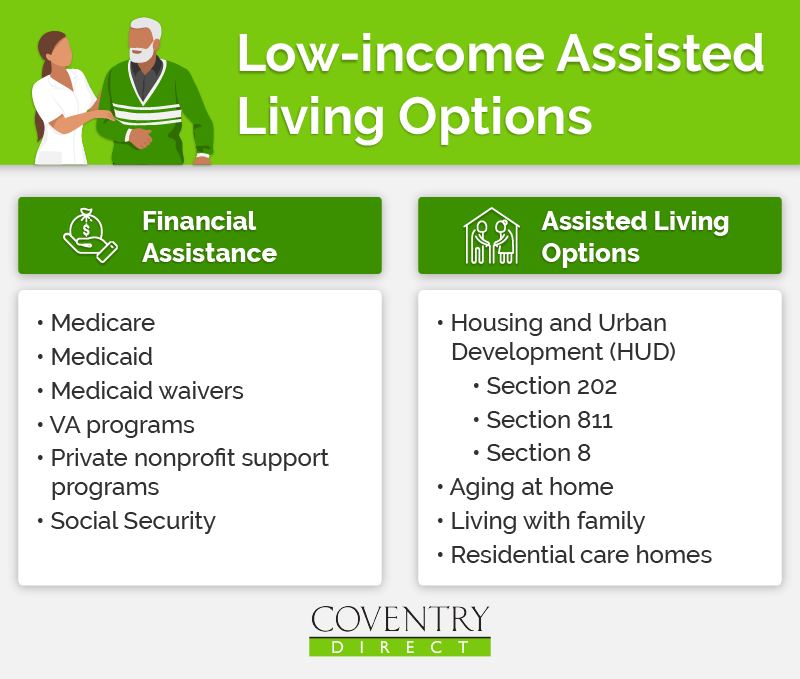
Assisted living costs can be a significant financial burden for low-income families, making it difficult to secure quality care for their loved ones. However, there are some programs and special benefits available to help cover the costs of assisted living for eligible individuals. Qualifications for the following options are typically based on income level, assets, and care needs.

Medicaid

Medicaid is a government program that provides health coverage to low-income individuals, including seniors needing long-term care services such as assisted living. While Medicaid rules and coverage vary by state, many states offer waivers or programs specifically designed to cover assisted living costs for those who meet eligibility requirements. Contact your state’s Medicaid program for more detailed information.

Supplemental Security Income (SSI)

SSI is a federal program that gives monthly payments to elderly or disabled individuals with limited income and resources. Some states supplement SSI payments with additional funds to help pay for assisted living costs. Eligibility criteria often include income and asset limitations and residency requirements.

Veterans Benefits

Veterans and their spouses may qualify for assisted living benefits through the U.S. Department of Veterans Affairs (VA). For instance, the Aid and Attendance (A&A) benefit provides additional financial assistance to veterans and surviving spouses who require help with daily activities due to a disability or health condition.
To qualify for Aid and Attendance benefits through the U.S. Department of Veterans Affairs (VA), individuals must meet specific criteria related to medical condition and financial need:

Medical Conditions
The applicant must require the assistance of another person with activities of daily living.
Individuals confined to a bed due to disability or chronic illness, residing in a long-term care facility due to physical or mental illness, or living with severe visual impairment may also qualify.

Financial Need
The applicant’s countable family income must be below the maximum annual pension rate set by Congress.
The veteran’s net worth must be under $138,489

Section 202 Supportive Housing for the Elderly Program

The Section 202 Supportive Housing for the Elderly Program, administered by the U.S. Department of Housing and Urban Development (HUD), provides affordable housing options and support services tailored to the needs of low-income seniors. Under this program, eligible individuals can access rental assistance in designated housing developments specifically designed for elderly residents. These developments often offer amenities such as communal spaces, transportation services, meal programs, and access to on-site supportive services, including assistance with activities of daily living and coordination of medical care. Section 202 aims to promote independent living and enhance the quality of life for seniors in need of affordable housing and support.

Long-Term Care Insurance

Long-term care insurance policies can help cover the costs of assisted living services. While premiums can vary based on factors such as age, health status, and coverage options, some policies offer benefits specifically for assisted living expenses. It’s crucial for families to look closely at the policy’s coverages and premiums, as some may provide little care for a premium similar to the cost of assisted living itself. Low-income individuals may explore more affordable insurance options or seek assistance from state programs to obtain coverage.

Non-Medicaid State Assistance

Non-Medicaid state assistance programs offer financial aid, caregiver support, and housing assistance to low-income seniors outside the Medicaid framework. These programs vary widely by state and can provide services such as cash benefits, home and community-based services waivers, and subsidies for assisted living or long-term care. Eligibility criteria often consider income, assets, and level of need, providing additional support to seniors who may not qualify for Medicaid but require assistance with housing and caregiving expenses.

AssistedLiving1

What Is Included in Assisted Living Costs?

In addition to being a big life decision, entering assisted living is an important financial decision. Assisted living costs provide residents with housing accommodations, the option of prepared meals, and medical care.

Housing

Most assisted living communities offer apartment-style residences with one or two-bedroom units, a kitchen, bathroom, internet, and cable. Apartments typically come with safety features such as handrails and alert devices to accommodate physical impairments. Residents can bring their furniture and belongings to their apartment and receive assistance with tasks like housekeeping and laundry. The cost of housing will depend on the apartment size, selected services, and other related factors.

Medical Care

The level of medical care and personal assistance provided at assisted living facilities can vary, though residents are expected to be relatively self-sufficient. Assisted living costs will increase or decrease with the level of daily care seniors receive. Those who can take care of themselves with minimal assistance will require limited medical services, reducing assisted living costs. Those who need considerable assistance to function regularly will require a higher level of medical care, increasing the cost. If the need for care exceeds the abilities of the facility, a resident could hire outside home care assistance or begin planning a transition to a skilled nursing facility.

Food

Assisted living communities offer significant flexibility throughout their living experience, and seniors can enjoy considerable flexibility around their dining experience and food preparation. Residents can choose to cook for themselves or receive food prepared by the facility. Those who prepare their meals themselves will pay less than those who eat facility-provided meals. The food served in assisted living communities can be high-quality and personalized to dietary requirements. Seniors can enjoy a community dining experience, often in a restaurant, resort, or hotel-style setting with other residents.

Is There Any Financial Assistance for Assisted Living?

For many seniors, paying for assisted living is a daunting prospect, especially for those in need of assisted living for low income. While it is important to plan ahead and be prepared for the eventual need to pay for assisted living, there are options available to seniors who may not be able to fully cover the costs involved.

Does Medicaid or Medicare Cover Assisted Living Costs?

In discussions about senior care costs, the common question is, “Does Medicaid or Medicare pay for assisted living expenses?” While Medicaid and Medicare typically do not cover assisted living costs, the specific answer to this question depends on several factors and varies from state to state. In addition, the level of coverage will ultimately depend on the senior’s health conditions and other specifics.

Government assistance alone, including Social Security, will not fund assisted living expenses, especially if a senior has specific geriatric needs. Therefore, it is best to develop a supplementary payment method. Assisted living is primarily a private pay environment requiring financing options such as the sale of a home or other assets, LTC life settlements, long-term care insurance, VA Aid & Attendance Benefits, and Senior Bridge Loans.

Are There Veterans Benefits for Assisted Living?

Veterans benefits are a great way for eligible seniors to contribute to their senior care income. Several veterans’ aid and pension options provide money for veterans’ assisted living costs or their single surviving spouses and dependent children.

For example, VA Aid and Attendance Benefits provide a monthly allowance for qualifying veterans who served active duty during wartime and were honorably discharged. In 2021, the monthly pay range seniors could spend on long-term care from the VA Benefit is:

Veteran= $2,050
Veteran and Spouse= $2,431
Surviving Spouse= $1,317
Two Married Veterans= $3,253

To receive veterans benefits for assisted living costs, seniors must apply and provide information about their income and assets, level of independence, and current medical conditions and/or disabilities. Senior veterans’ physical or mental impairments do not have to be a product of military service to qualify.

Assisted Living vs Nursing Home Cost: What’s the Difference?

If a senior you know is considering entering an assisted living facility, they are likely considering another form of senior care: nursing homes. Unfortunately, understanding the difference between assisted living and nursing homes can be difficult. Although nursing homes and assisted living offer care and personal assistance, these two forms of long-term care vary widely in their levels of care, services, and costs.

Assisted living facilities primarily offer care to seniors in reasonably good health who are no longer capable or want to live alone. Rather than providing skilled medical care, assisted living facilities offer more assistance with everyday activities such as dressing and bathing. In contrast, nursing homes tend to individuals with severe health conditions that require significant medical care and assistance with ADLs, and medication management.

Because they provide much more extensive healthcare than assisted living facilities, nursing homes cost over twice as much per month on average. While this hefty cost places a heavy financial burden on seniors, nursing homes provide comprehensive care from skilled medical professionals. For example, suppose an aging senior was bound by a bed or wheelchair, in the late stages of a cognitive illness like dementia, or had complex treatment needs. Nursing homes could provide them with the constant care they need to manage the most advanced health conditions. Medicaid is the primary payor of nursing home costs in the U.S., but to qualify an applicant would need to meet asset and income limits placing them below the poverty line.

AssistedLiving3

How to Pay for Assisted Living Costs

It’s time to get into the different ways seniors can pay for assisted living costs. Whether it’s cash, health insurance, or life insurance—the section below provides an overview of the various methods seniors can use to fund their residence in an assisted living facility.

Long-Term Care Insurance

Long-term care insurance offers a smart way to cover assisted living expenses for those looking ahead at future senior care costs. Like many state and federal assistance programs, long-term care insurance has eligibility requirements that depend on the type of policy a senior pursues. While long-term care insurance can help seniors pay for assisted living costs, this type of insurance can be expensive and typically covers a fixed period.

Out of Pocket

When seniors have sufficient funds, they can pay out of pocket for long-term care. It allows them to access high-quality living assistance without dealing with an insurance policy or navigating Medicare and Medicaid restrictions. Cash reserves from personal savings can fund out-of-pocket payments. Also, the sale of assets, such as a vehicle or home that a senior will no longer need can fund these payments.

Life Insurance

Seniors who are looking for more affordable assisted living options, and who have life insurance, can sell their policy in return for a cash sum or long-term care benefit account, which they can use to fund long-term care. This type of policy sale is called a life settlement. It allows seniors to get a much more generous payout, on average 5-10 times greater, than they would by canceling their policy or letting it lapse.

Qualifying policy owners can receive a portion or, in some cases, all of a life settlement’s payout free of taxes. Proceeds equal to or less than the sum of the premiums the policy owner has paid on their policy, called the tax basis, will not be subject to taxation. In addition, if the insured person is terminally ill or chronically ill, the policy sale is called a viatical settlement, and the proceeds are tax-free. All assisted living communities will accept funds from a life settlement being held and administered through a Long-Term Care Benefit Account. A recently reintroduced congressional bill could even make life settlement proceeds tax-free for everyone through a long-term care benefit account.

Know the Options Available for Paying for Assisted Living Costs

The decision to give up a degree of independence can be a difficult moment in any senior’s life. Assisted living facilities do their best to make this transition as positive and gratifying as possible. Though some may be concerned about finding a way to pay assisted living costs, seniors today have many options to help them finance this important senior expense.

Retirement Genius can help seniors understand all of their financing options—from life settlements to long-term care insurance. Our retirement experts are here to guide seniors through the early preparation phase and plan a happy, healthy, and fulfilling retirement. To see how our years of experience and accumulated expertise can help you meet your retirement goals, contact Retirement Genius today.


View Transcript

Retire like a genius. How to become a long-term care genius? Ways to pay for long-term care when you need it now. Long-term care is a topic most people don’t want to think about and way too few people are financially prepared for. The expensive costs of home care, assisted living communities, memory care, and nursing home care. But the reality is that 70 percent of people over the age of 65 will need to pay for long-term care services in their lifetime. For the lucky few that have long-term care insurance or enough money to pay out of pocket for what they need they’ll be able to choose the type of care and location that they want. So what can people do if they don’t have the ability to pay for these services at the time they need them. Many people don’t realize that they actually have access to a variety of funding resources that could be sitting in their hands right now. So here are financial options to consider when you need to pay for long-term care now. One life settlements, Sell off an unneeded or unwanted life insurance policy to access tax Advantage Funds that can be used to pay for any form of long-term care. Two reverse mortgage, a lone taken out against the equity in a home without the need to make monthly loan payments that can be used to pay for home care services. Three VA aid and attendance benefit, veterans and or a spouse can access a monthly benefit to pay for long-term care costs if they meet eligibility requirements. Four annuities, can be used to create a guaranteed monthly income to help pay for long-term care services for the remainder of a person’s life. Five senior bridge loans, a loan to pay for care that’s needed today taken out to bridge the time it takes to sell a home to fund care for the long term. Six true freedom plan, a prepaid membership plan that will cover different levels of hours of Home Care Services in the future when they are needed. It’s important for people to do all they can to prepare for their future retirement and long-term care needs. But for those who have not adequately prepared and are now facing an immediate need for care they have more financial options available to them than they may have realized. Retire like a genius it’s always best to work with information and experts to help you navigate these tricky issues so visit retirement genius today to learn more about how to retire like a genius.

When is Home Care for the Elderly the Right Option?

It can be hard to decide what type of care is best for your loved ones as they age. Many older adults don’t want to leave their homes, even if diagnosed with dementia or Alzheimer’s disease. Rather than relocating to an assisted living facility or nursing home, they want to continue living in their home to stay connected to their community and maintain independence. When this happens, senior home care becomes a practical option.

Home care aides help seniors age comfortably in their own homes with services that are personalized to their individual needs. If you’re considering home care for your loved one, there are some things to remember that will help ensure they are happy, healthy, and safe. We put together this guide to help you understand those factors so you can make the right decision for their care and ensure they age in a safe and comfortable environment.

What is Home Care?

Home care is any professional support service that allows a person to live safely in their home. Professional caregivers such as nurses, aides, and therapists provide short-term and long-term care in the home, depending on the person’s needs. They care for aging individuals who have serious medical conditions, need assistance to live independently, manage chronic health issues, recover from a medical setback, or have special needs or a disability. They also provide companionship and assistance with basic household tasks. Home care aids are appropriate for those who want to stay in their home and need ongoing care that family members or friends cannot provide.

Home care aides visit the home daily or just a few times a week, depending on the level of care a person needs. Most home care aides help with non-medical services, but skilled health care services can also be delivered at home, including:

  • Assistance with daily activities such as dressing, walking, bathing, and using the toilet
  • Managing tasks around the home, including light housekeeping and meal preparation
  • Companionship and supervision
  • Therapy and rehabilitation services
  • Medication Management
  • Short or long-term nursing care for an illness, disease, or disability

Home care differs from other forms of elderly assistance, like nursing homes and assisted living facilities. While some nursing homes are designed to mimic a home and not feel like a hospital, they can sometimes remove an individual’s independence and lead to frustration. Nursing homes also have a rotating staff of medical professionals to assist with everyday activities and serve residents three meals a day. Assisted living facilities offer seniors care in a residential setting that isn’t their home while providing social engagement and amenities for a healthy lifestyle. They cater to seniors who can live independently but generally don’t provide personalized care.

Benefits of Home Care for the Elderly

Home care enables safety, security, and increased independence, helping your loved one achieve the highest quality of life possible. Home care is an alternative to full assisted living if they need help with basic tasks or are experiencing memory loss but are otherwise reasonably healthy. It can ease management of an ongoing medical condition and avoid unnecessary hospitalization through care given in the comfort and familiarity of home. For many families, home care is the best solution because it allows their loved one to stay home and continue to live the life they’re used to living. There are many benefits of home care, such as:

  • Comfort: Your loved one can stay in the place where they are most comfortable. They can sleep in their own bed, use their own bathroom, and continue their daily routine.
  • Personalized care: Rather than adjust to a nursing home or care facility’s schedule, a home care plan is personalized and designed to fit your loved one’s routine.
  • Family Involvement: Home care allows the family to be a large part of their loved one’s care plan, with a direct line of communication between caregiver and care manager. It also provides a break for family members maintaining full-time jobs.
  • Independence: Loss of independence is a primary concern for seniors when their family considers care options. Home care allows them to maintain control of their daily lives, choosing when they want to eat, sleep, and socialize.
  • Companionship: Seniors who live alone often feel isolated and lonely, which can lead to a decline in health. Home care aides can provide your loved one with a familiar face, friendly conversation, and a meaningful human connection.
  • Peace of mind: You won’t have to worry about a loved one falling and injuring themselves as they perform their daily activities, such as showering or cooking. You’ll be able to rest easy knowing they are receiving good care.
  • Stay together: Home care allows elderly couples who need different levels of care to continue living together in their home. Separating elderly couples can lead to mental health concerns and poor health.

Warning Signs a Senior May Need Home Care

Noticing the subtle signs that your loved one may need help at home will ultimately lead to a safer and happier environment for them. Hiring a home care aide can help resolve more issues than you might realize. Sometimes, the signs that your loved one may need help at home aren’t so obvious.

In many situations the need for care will creep up on a family. Oftentimes, family members are acting as caregivers without realizing it. As the need for care increases, it can either seem like a normal part of aging or people are just not willing to admit that their ability to live independently is no longer possible—or safe. But there are warning signs people should be looking for that will help them recognize when the time for professional long-term care has arrived:

Physical Deterioration: Look for signs such as significant weight loss, balance issues and falling, loss of strength and stamina, and other losses of “Activities of Daily Living” known as an ADL such as ability to shower or toilet, dress, or eat independently.

Mental Deterioration: Do not blow off loss of memory or confusing names, dates and locations as just a “senior moment”. Cognitive deterioration is an important warning sign to be on the lookout for dementia and Alzheimer’s. These conditions can worsen quickly and can lead to many physical breakdowns and safety issues that are easily spotted.

Lifestyle Deterioration: Is your loved one’s appearance now disheveled? Is the home not being kept as neatly as in the past? Are things oddly out of place (a house plant in the fridge, pots and pans in the bathtub), or are there signs of physical damage (the car crashing into a fence or the wall of the garage, burn marks on the kitchen wall from a flash fire)? Long-term care is both a matter of healthcare and safety.

Memory Loss

It’s normal to forget some things as you age. Forgetting the names of old friends or misplacing your car keys are signs of mild forgetfulness. It’s a normal part of aging and not a serious problem. it’s one thing to walk into a room and not remember what you are looking for but it’s quite another to not know where you are. However, if your loved one’s memory loss gets worse over time, forgetfulness can lead to unpaid bills and missed medication or appointments, which can lead to serious health or financial consequences. Home care can help make these tasks more manageable, especially those who may otherwise be in good physical condition and aren’t ready to move into assisted living or nursing homes.

Aging Partners

When older individuals begin to experience health declines, it can become difficult to care for a partner, who may also be experiencing complex health conditions. Home care is an excellent option for elderly couples, who wish to age together in their home. Home care services can also provide different levels of care, particularly when one spouse develops health concerns and their partner cannot care for them.

Falls

As our loved ones age, they may begin to experience falls as they perform basic tasks— changing a light bulb or going up and down the stairs. Illness, medication, and loss of muscle mass can reduce their steadiness and coordination, so falls remain a top cause of seniors’ accidents. A home care aide can help prevent injury or a long and costly hospital stay by preventing them from engaging in household tasks or activities where they may be more prone to falling.

Loneliness

As individuals age, they can sometimes feel isolated and lonely, especially if they don’t have family members who live near them and cannot engage in social activities outside of their homes. Social isolation can lead to higher rates of depression and anxiety. Many seniors in this situation may be physically able to care for themselves but just need companionship to stay motivated and engaged. Home care aides can provide companionship and transportation for seniors who feel alone.

home care for the elderly

Determining if Home Care Is the Best Option

Each senior’s situation is different and requires different types of care services. Some may need help getting around their home, while other seniors require more complex, medically focused care. Navigating the various aspects of home care can be overwhelming, especially if you’re unsure what type of care is best suited for your loved one. Home care is ideal for those who need companionship, assistance with reminders and household tasks, and a high level of care to avoid hospitalization.

If your loved one needs someone to be with them 24 hours a day, home care may not be the best option. They should consider a nursing home or assisted living facility, depending on their needs. If their mobility is declining and their home isn’t easily accessible for this transition, home care isn’t ideal. In this instance, they should consider an assisted living facility. A care manager or home care aide can assess your loved one’s needs and develop a care plan or alternate care options best suited for them.

Paying for Home Care

Families are often concerned about how much home care services cost and what financial options there are for payment. Costs of home care vary across agencies, regions, and service types. It’s essential to understand your payment options before making the decision about home for your loved one. The popular options for funding your loved one’s home care are Medicare & Medicaid, health insurance, life insurance, reverse mortgages, VA Aid & Attendance, or paying out of pocket.

Medicare & Medicaid

In most cases, Medicare and Medicaid will pay for medically necessary services provided in a home setting, with coverage limits by the agency you choose.

Medicare focuses on necessary medical care and short-term care for conditions that will improve through rehabilitation services. So, in most limited cases, Medicare won’t pay for long-term care such as help bathing, dressing, eating, moving around, or using the bathroom. However, there are certain instances in which Medicare may contribute, such as physical and occupational therapy, short-term hospital stays, and hospice care. Medicare also requires the individual’s doctor to certify that the care is necessary. Medicare will also fund hospice care received at home.

Medicaid is the largest public funder of long-term care services. It covers long-term home care services like help bathing or dressing for those who meet certain eligibility requirements that vary by state. If you’re eligible, the state will also make an additional determination on whether your loved one qualifies for long-term care services at home. But Medicaid funded care received at home is available on a limited basis.

Health Insurance

While there are exceptions, health insurance may have limited coverage for some aspects of long-term home care. Most health insurance policies cover some doctor-prescribed home care for health issues, usually following a hospital stay. However, no health insurance policy will fully cover long-term care. Nonetheless, you should check with your private health insurance to understand what is and isn’t covered.

Out of Pocket

Some families choose to pay for home care privately from their income, savings, or sharing expenses with other family members. If your loved one needs minimal assistance (one or two brief visits a week), helping out yourself or paying out of pocket for home care may be a good option. However, as expenses rise, this may become more and more challenging for those on a fixed income.

Private Pay

Seniors on a fixed income looking to pay for home care may be able to access a variety of options based on assets or benefit programs.

The owner of a life insurance policy can consider selling their life insurance policy for cash using Long-term care (LTC) life settlements and then set up a LTC Benefit Account to make monthly payments towards care. This option is designed for seniors who want to unlock the value in a life insurance policy that they no longer need to pay for any form of senior living and long-term care they may want.

Life settlements are another financially savvy way to free up cash to help you or your loved one stay in your home and pay for your in-home care. As the sale or transfer of the death benefit or ownership of a life insurance policy, your loved one can sell it and use the money they receive to fund their home care.

Veteran’s Aide & Attendance Benefits are for veterans of active combat duty and/or their spouses are eligible to receive monthly benefits paid directly towards qualifying long-term care service. Like Medicaid, the applicant must meet both medical necessity and income/asset level requirements to qualify.

Reverse Mortgage
Homeowners with little to no remaining mortgage balance that are age 62 or older can qualify to take a HUD backed Home Equity Conversion Mortgage (HECM) loan against the home in the form of a lump sum, monthly income or a line of credit. To qualify the home must still be the primary residence and the loan must be paid back with interest and fees after the homeowner dies (typically through the sale of the property).


Home care can provide your loved one with the opportunity to continue living in their home, with help they need with cooking, cleaning, bathing, and performing other parts of their daily routine. You know they will have personalized care that meets their needs. They will have a friendly and familiar face visiting them daily or weekly for continued comfort. The experts at Retirement Genius can guide you through your options and help you decide if home care is the right fit for you and your family, and the best approach. Contact the experts at Retirement Genius today.

Bio: Chris Orestis is the founder and President of Retirement Genius and an expert in strategic retirement planning. Having appeared on CNBC, Fox News, and USA Today, Chris uses his 25-plus years of retirement experience to help seniors transition to the next chapter of their lives with grace and financial security.

Retire Like A Genius℠

Retirement Genius tips, tricks, and more are delivered right to your inbox. Sign up today and learn to Retire Like a Genius.